
SkinCeuticals Tripeptide-R Neck Repair Review
The Verdict
Tripeptide-R Neck Repair fills a genuine gap rather than repackaging a facial cream for a new area — the neck and décolletage age differently and often react more readily to actives, and a 0.2% slow-release retinol formulated specifically for that skin, backed by a tripeptide concentrate and glaucine complex, reflects that. It's a considered pick for anyone with horizontal neck lines, crepiness or firmness loss, including first-time retinol users, provided it's phased in gradually like any retinoid. It isn't a substitute for a facial retinol elsewhere in your routine, and SkinCeuticals' own study figures are the brand's reported results rather than independently verified data — read them with that caveat. Check the product page for current pricing and stock.

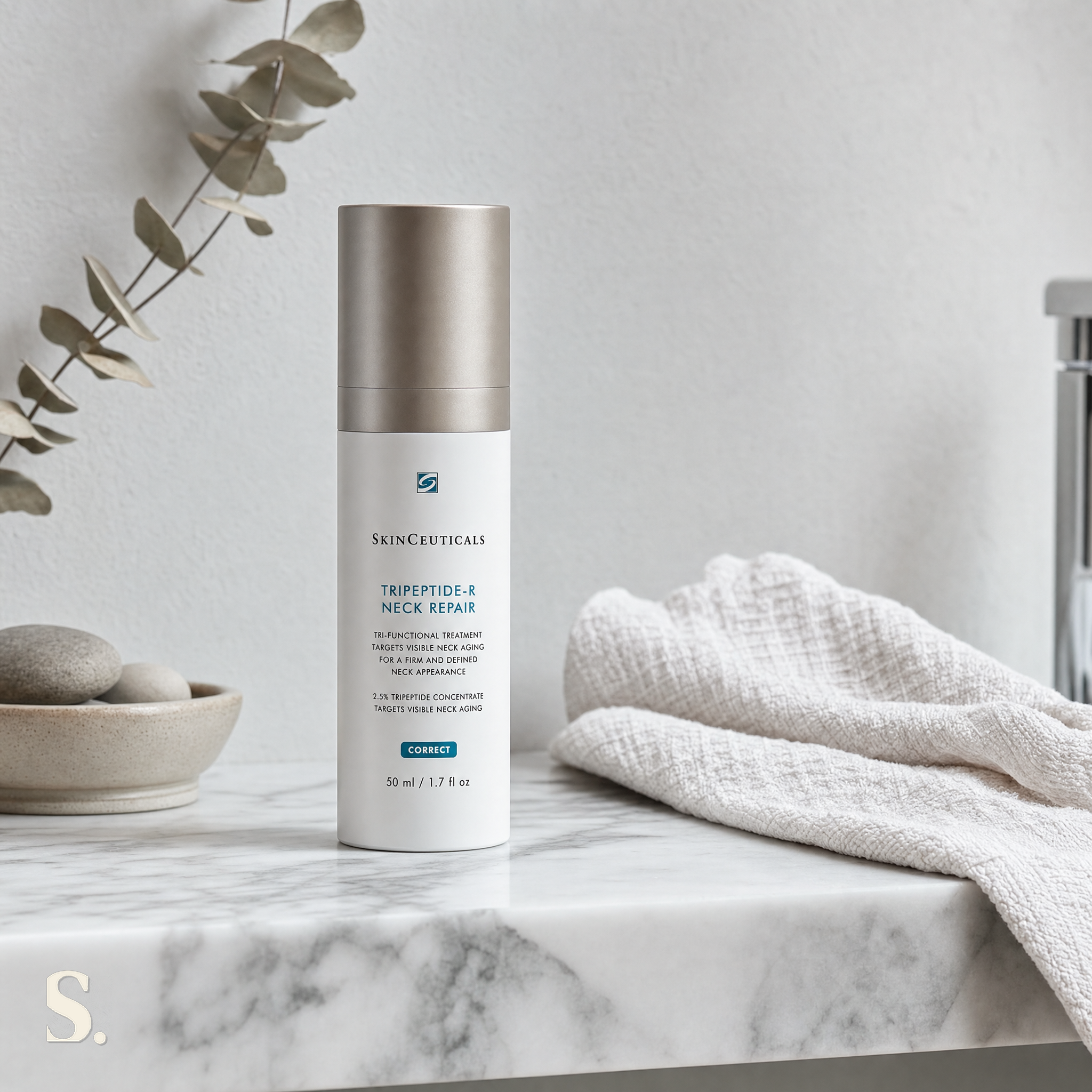
SkinCeuticals Tripeptide-R Neck Repair | Retinol Neck Cream | 50ml
£133.00
SkinCeuticals Tripeptide-R Neck Repair is a 50ml cream built around 0.2% Pure, Slow-Release Retinol, a 2.5% Tripeptide Concentrate and a 5.0% Glaucine Complex, formulated specifically for the neck and décolletage. It targets horizontal neck lines, crepiness and loss of firmness — including "tech neck" from repeated downward phone use — and is positioned as gentle enough for first-time retinol users when introduced gradually.
What is SkinCeuticals Tripeptide-R Neck Repair?
Tripeptide-R Neck Repair is SkinCeuticals' dedicated corrective cream for the neck and décolletage — an area the brand notes is thinner, more delicate and often more reactive than facial skin, and one that's frequently left out of a skincare routine altogether. Rather than diluting a facial retinol, the formula is calibrated for that difference: 0.2% Pure, Slow-Release Retinol is paired with a 2.5% Tripeptide Concentrate and a 5.0% Glaucine Complex, which per SkinCeuticals' own product description work together to support cellular renewal, fortify skin structure and help resist collagen breakdown.
It's formulated for all skin types, including sensitive skin, and is positioned by SkinCeuticals as suitable for first-time retinol users specifically because of the slow-release delivery — though as with any retinoid, that's a reason to introduce it carefully rather than a reason to skip the usual phase-in.
Key facts
| Format | Cream, for neck and décolletage |
|---|---|
| Size | 50ml |
| Key actives | 0.2% Pure, Slow-Release Retinol; 2.5% Tripeptide Concentrate; 5.0% Glaucine Complex |
| When to use | Evening, starting twice-weekly and building up gradually |
| Skin types | All skin types, including sensitive skin, introduced gradually |
| Price | Premium price band — check the product page for the current price |
Key ingredients
| Ingredient | What it's there for |
|---|---|
| Pure, Slow-Release Retinol (0.2%) | The vitamin A active, calibrated to a lower strength and slower release than a typical facial retinol, aimed at the neck's thinner skin |
| Tripeptide Concentrate (2.5%) | Included to help support skin firmness and structure |
| Glaucine Complex (5.0%) | Included to help resist collagen breakdown |
SkinCeuticals hasn't published a full INCI list in the product description we reviewed — check the ingredients panel on the product page directly before use if you have known sensitivities or allergies.
Who it's suitable for
Per SkinCeuticals' own product description, this is aimed at anyone with horizontal neck lines, crepiness or loss of firmness in the neck and décolletage, including people concerned about "tech neck" from repeated downward gazing at phones. SkinCeuticals also positions it for those wanting to complement in-clinic neck procedures such as cryolipolysis or skin-tightening treatments with a homecare step, and for first-time retinol users specifically, on the basis of the slow-release formulation.
Because it's built for a specific, more delicate area rather than as a general anti-ageing cream, it's worth being clear about what it isn't: it's not designed to replace a facial retinol, and it isn't a once-a-week spot treatment. If you have a diagnosed skin condition — including rosacea, eczema or another inflammatory condition — retinoids can behave differently from one person to the next, so we'd recommend talking to our team or a dermatologist before starting, rather than assuming this product will or won't suit you based on a review.
How to use it
- Where: Neck and décolletage, on cleansed, dry skin — it's formulated for this area specifically, not the face.
- When: Evening, as retinol increases sun sensitivity and isn't formulated for daytime use.
- Phasing in: SkinCeuticals recommends starting with twice-weekly application to let skin acclimatise to the retinol, then gradually building tolerance from there — this is the brand's own stated starting guidance for this product, not a generic phase-in rule.
- Next morning: Broad-spectrum SPF on the neck and décolletage, every day you're using it — an area that's easy to miss with sunscreen.
How it feels to use
Per SkinCeuticals' own product description, this is a rich, hydrating cream that absorbs comfortably without leaving a greasy residue, with a texture designed to glide across the neck and décolletage and provide a subtle tightening sensation on application. As with any retinoid, some mild tingling or warmth during the first few weeks is common and typically settles as skin adjusts to the twice-weekly starting schedule.
What to expect
SkinCeuticals' own product description cites a 16-week study in which participants reported an average 27% improvement in the appearance of neck crepiness, a 28% improvement in skin smoothness, and 16% improvement in both horizontal neck lines and skin firmness. This is SkinCeuticals' own reported result, not an independently verified trial, and the description we reviewed doesn't publish participant numbers, methodology or peer-review status — so treat the figures as the brand's claim rather than an outcome we can guarantee, and see the data gap below. Used consistently and paired with daily SPF, retinol formulas like this one are generally understood to help improve the appearance of fine lines and texture over time through supporting skin cell turnover.
Pregnancy and breastfeeding
If you're pregnant or breastfeeding, please contact our team for advice before use.
This applies to Tripeptide-R Neck Repair and to every retinoid SkinCeuticals sells, including Retinol 0.3%. We won't state that a product is or isn't safe in pregnancy in this review — that's a conversation for you, your midwife or GP, and our team, not a blanket line in a product write-up.
How it fits with the rest of your routine
Tripeptide-R Neck Repair is designed to sit alongside, not replace, a facial retinoid. If you're starting a retinoid for the first time and want a matching product for the face, our Retinol 0.3% review covers SkinCeuticals' entry-strength facial option, built on the same gradual phase-in principle. If glycation-related firmness loss and dullness are more of a concern than fine lines specifically, A.G.E. Interrupter Advanced targets that mechanism instead of — or alongside — a retinoid.
For the wider anti-ageing shelf across the brand, including how a neck-specific step fits into a full routine, see our Best SkinCeuticals Anti-Ageing guide. For an overview of the full range, start with our SkinCeuticals brand guide.
FAQs
Can I use SkinCeuticals Tripeptide-R Neck Repair if I'm pregnant or breastfeeding?
If you're pregnant or breastfeeding, please contact our team for advice before use. We don't state a blanket safe/unsafe position on retinoids in pregnancy in our reviews.
What's the difference between this and SkinCeuticals Retinol 0.3%?
Retinol 0.3% is formulated for the face at a slightly higher retinol strength; Tripeptide-R Neck Repair uses a lower, 0.2% slow-release retinol calibrated for the neck and décolletage's thinner, more delicate skin, alongside a tripeptide concentrate and glaucine complex the facial cream doesn't contain. They're designed to be used together, on different areas, rather than as alternatives to each other.
Can I use it alongside A.G.E. Interrupter Advanced?
SkinCeuticals doesn't publish a specific combined-use instruction for these two in the description we reviewed. Because A.G.E. Interrupter Advanced targets glycation rather than containing a retinoid itself, the two address different mechanisms, but as with combining any active-ingredient products, ask our team before layering them into the same routine.
How often should I apply it when starting out?
SkinCeuticals recommends starting with twice-weekly application to let the neck and décolletage acclimatise to the retinol, then gradually building tolerance from there — rather than applying it nightly from day one.
Is it suitable for sensitive skin?
SkinCeuticals positions it as suitable for all skin types, including sensitive skin, when introduced gradually. As with any retinoid, if you have a diagnosed inflammatory skin condition, it's worth checking with our team or a dermatologist before starting.
Does this replace a facial retinol?
No. It's formulated specifically for the neck and décolletage's thinner skin, at a lower retinol strength than most facial formulas, and is designed to be used alongside a separate facial retinol such as Retinol 0.3% rather than instead of one.
Our verdict
Tripeptide-R Neck Repair fills a genuine gap rather than repackaging a facial cream for a new area — the neck and décolletage age differently and often react more readily to actives, and a 0.2% slow-release retinol formulated specifically for that skin, backed by a tripeptide concentrate and glaucine complex, reflects that. It's a considered pick for anyone with horizontal neck lines, crepiness or firmness loss, including first-time retinol users, provided it's phased in gradually like any retinoid. It isn't a substitute for a facial retinol elsewhere in your routine, and SkinCeuticals' own study figures are the brand's reported results rather than independently verified data — read them with that caveat. Check the product page for current pricing and stock.