
Best Obagi Vitamin C Serum for Brightening & Uneven Tone
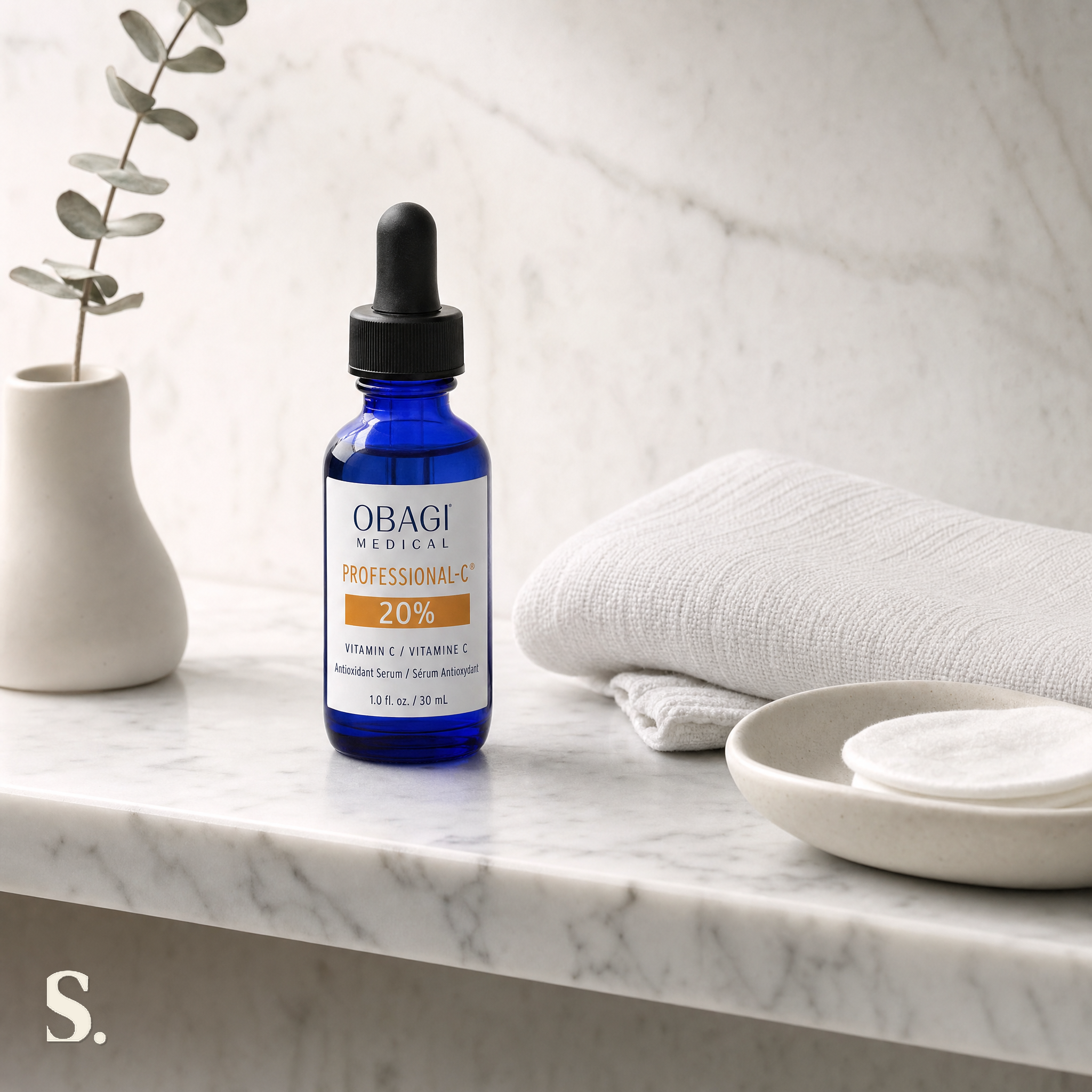
Obagi's vitamin C range isn't a single serum — it's three strengths of the same Professional-C formula (10%, 15%, 20%) plus a separate dual-active option, Obagi-C Fx C-Clarifying Serum, built around L-Ascorbic Acid and Arbutin together. Our lead pick is Professional-C Serum 20% for vitamin-C-tolerant skin wanting maximum strength; if you're newer to vitamin C or have dry or sensitive skin, Professional-C Serum 10% is the safer starting point. This page breaks down all four so you can pick the right one rather than guessing by percentage alone.
The four Obagi vitamin C serums at a glance
| Serum | Key actives | Format | Price band | Best for |
|---|---|---|---|---|
| Professional-C Serum 20% | L-Ascorbic Acid (20%), Sodium Hyaluronate | 30ml fluid | £££ | Vitamin-C-experienced skin wanting maximum strength |
| Professional-C Serum 15% | L-Ascorbic Acid (15%), Ascorbyl Glucoside | 30ml fluid | £££ | Stepping up from 10%, not yet ready for 20% |
| Professional-C® Serum 10% | L-Ascorbic Acid (10%) | 30ml fluid | ££ | First-time vitamin C users; dry, sensitive or reactive skin |
| Obagi-C® Fx C-Clarifying Serum | L-Ascorbic Acid (10%), Arbutin (4%) | 30ml fluid | £££ | Pigmentation-focused brightening, dual-active formula |
Price bands: £ under £70 · ££ £70–£120 · £££ £120–£180 · ££££ £180 and over.
1. Obagi Professional-C Serum 20% — our lead pick
Professional-C Serum 20% is the strongest of Obagi's three Professional-C strengths, built around L-Ascorbic Acid at 20% alongside Sodium Hyaluronate for hydration, plus Ascorbyl Glucoside, Zinc Chloride and Sorbitol in the supporting formula. It's a 30ml fluid serum formulated for normal, oily, combination and mature skin, and Obagi's own product listing states that in its own testing, 91% of users reported skin appeared brighter and more hydrated, alongside a brand-cited 2023 in-vitro study on protection against blue light and infrared-related oxidative stress — this is Obagi's own reported testing rather than an independently verified clinical trial, so treat it as a manufacturer claim.
Obagi's directions state daily morning use, applied after cleansing and toning and before moisturiser, with a broad-spectrum SPF to follow. Obagi's own expert tip notes that a slight tingling sensation is normal and typically fades with continued use, and specifically suggests starting at 10% or 15% first if you're new to vitamin C before working up to 20%. That's the honest caution here: this is the maximum-strength option, not a first vitamin C serum.
2. Obagi Professional-C Serum 15% — the middle strength
Professional-C Serum 15% shares the same L-Ascorbic Acid backbone at a mid-range concentration, plus Ascorbyl Glucoside as a stabilised vitamin C derivative for additional antioxidant support. It's formulated for normal, combination, dry, oily and mature skin, in the same 30ml fluid format, for daily morning use after cleansing and toning. Obagi positions this as suited to normal-to-combination skin specifically — a step up from the 10% for those who've found it too mild, without going straight to the maximum 20% strength.
3. Obagi Professional-C® Serum 10% — start here if you're new to vitamin C
Professional-C® Serum 10% is Obagi's gentlest strength, built around L-Ascorbic Acid at 10% with Propylene Glycol and Propylene Carbonate supporting stability and hydration. Obagi's own listing positions it specifically for dry, sensitive and reactive skin, and it's the formula we'd point vitamin-C-naive skin toward first, whatever your longer-term goal — you can always move up to 15% or 20% once your skin has built tolerance.
4. Obagi-C® Fx C-Clarifying Serum — vitamin C plus a second brightening active
Obagi-C Fx C-Clarifying Serum is a different formula rather than a fourth strength on the same ladder. It pairs L-Ascorbic Acid (10%) with Arbutin (4%), a tyrosinase-inhibiting brightening ingredient derived from bearberry, working alongside the vitamin C rather than instead of it. Obagi markets it as the hydroquinone-free, non-prescription entry point to its Obagi-C Fx System, suited to normal, oily, dry, combination and sensitive skin, for daily morning use. If pigmentation and uneven tone specifically — rather than antioxidant strength on its own — are what you're trying to address, this dual-active formula is worth comparing against the plain Professional-C options above.
Worth knowing: Obagi Nu-Derm Blend Fx isn't a vitamin C serum
Obagi Nu-Derm Blend Fx often comes up in the same searches as Obagi's vitamin C range, so it's worth being clear about what it actually is: a brightening cream built around Arbutin (7%) and Lactic Acid, with Ascorbic Acid (Vitamin C) and Tocopheryl Acetate (Vitamin E) playing a supporting antioxidant role rather than the headline job. It's an evening-only step in the Nu-Derm system, and Obagi's own directions describe mixing it with a retinoid such as Obagi Retinol 0.5% for combined brightening and anti-ageing use, or applying it standalone. If you're specifically shopping for a vitamin C serum, it isn't the right product to reach for — but if you're building a fuller Obagi routine around your Professional-C or Obagi-C Fx pick, it's a reasonable regimen pairing to be aware of, and the standalone review covers it in full.
How to choose between the three Professional-C strengths
- Never used vitamin C before, or have dry/sensitive/reactive skin: start with Professional-C Serum 10%.
- Already using vitamin C and want a stronger step without jumping to maximum strength: Professional-C Serum 15%.
- Vitamin-C-tolerant skin wanting the most potent option Obagi sells: Professional-C Serum 20%.
- Pigmentation or dark spots are your main concern, not just antioxidant strength: Obagi-C Fx C-Clarifying Serum, for its added Arbutin.
For a closer side-by-side on the three Professional-C strengths specifically — including how the tingling sensation and build-up advice differs across all three — see our Professional-C Serum 10% vs 15% vs 20% comparison.
Who should be cautious with any Obagi vitamin C serum
- Anyone with a known sensitivity to vitamin C, L-ascorbic acid or fragrance — Professional-C 10%, 15% and 20% all list Parfum/fragrance among their ingredients, so check the allergen note on each product page if fragrance is a concern.
- First-time vitamin C users going straight to the 20% strength — Obagi's own guidance is to build up from 10% or 15% first.
- Anyone layering vitamin C with other strong actives (retinoids, high-frequency AHA/BHA) in the same routine without spacing them out.
Looking for vitamin C outside the Obagi range?
This page is deliberately Obagi-specific. If you want to compare vitamin C serums across every brand Skintique stocks rather than staying inside one range, our wider guide to the best vitamin C serums in the UK covers that ground instead. For more on how the Obagi range fits together as a whole — including where Nu-Derm, ELASTIderm and CLENZIderm sit alongside Professional-C — see the Obagi reviews hub.
Our verdict
If you only take one thing from this page: Obagi's vitamin C serums aren't interchangeable by percentage alone, and picking the wrong strength is the most common way to end up with irritation or a product that feels like it isn't doing much. Professional-C Serum 20% is our lead pick for vitamin-C-tolerant skin wanting Obagi's strongest formula; step down to 15% or 10% if you're newer to vitamin C or have reactive skin; and if pigmentation specifically is your concern, Obagi-C Fx C-Clarifying Serum's added Arbutin makes it worth comparing against the plain Professional-C options before you buy.
If you're pregnant or breastfeeding, please contact our team for advice before use.
Frequently asked questions
What is the best Obagi vitamin C serum?
For most vitamin-C-tolerant skin, Professional-C Serum 20% is our lead pick — Obagi's highest-strength L-Ascorbic Acid formula. If you're new to vitamin C or have dry, sensitive or reactive skin, start with Professional-C Serum 10% instead.
What's the difference between Obagi Professional-C 10%, 15% and 20%?
All three use the same L-Ascorbic Acid active at different concentrations — 10%, 15% and 20% respectively — with 10% formulated specifically for dry and sensitive skin, and 20% positioned as the maximum-strength option for skin that's already vitamin-C-tolerant. 15% sits between the two as a middle step.
Is Obagi Professional-C Serum 20% too strong for beginners?
Obagi's own guidance suggests starting at 10% or 15% if you're new to vitamin C, then building up to 20% once your skin has developed tolerance, rather than starting at the maximum strength.
What's the difference between Obagi-C Fx and Obagi Professional-C Serum?
Obagi-C Fx C-Clarifying Serum combines L-Ascorbic Acid (10%) with Arbutin (4%), a second brightening active that targets pigmentation directly. The plain Professional-C serums (10%, 15%, 20%) contain L-Ascorbic Acid as their headline active without Arbutin.
Can I use Obagi vitamin C serum with retinol?
Vitamin C and retinol can generally be used in the same routine, but Obagi's own directions for the Professional-C range recommend vitamin C in the morning and pairing retinol use in the evening, rather than layering both actives at the same time of day.
Is Obagi Nu-Derm Blend Fx a vitamin C serum?
No. It's a brightening cream built primarily around Arbutin and Lactic Acid, with Vitamin C playing a secondary antioxidant role. If you're specifically after a vitamin C serum, one of the four products above is the better fit.
Is Obagi vitamin C serum safe to use if I'm pregnant or breastfeeding?
If you're pregnant or breastfeeding, please contact our team for advice before use.