
AlumierMD Retinol Resurfacing Serum Review
The Verdict
Retinol Resurfacing Serum does what a strength-ladder retinol should: it gives you a clear, low-risk entry point at 0.25%, a defined route up to 0.5% and 1.0% once your skin has adjusted, and a supporting cast of niacinamide and hydrators that AlumierMD includes specifically to soften the introduction. It isn't a gentler alternative to retinol's usual demands — AlumierMD's own guidance is explicit that mild redness, peeling or tingling should be expected at first, and daily SPF the following morning isn't optional. Choosing the right strength to start on, rather than reaching for whichever bottle is in stock, is the part that actually determines how comfortable the first few weeks are.

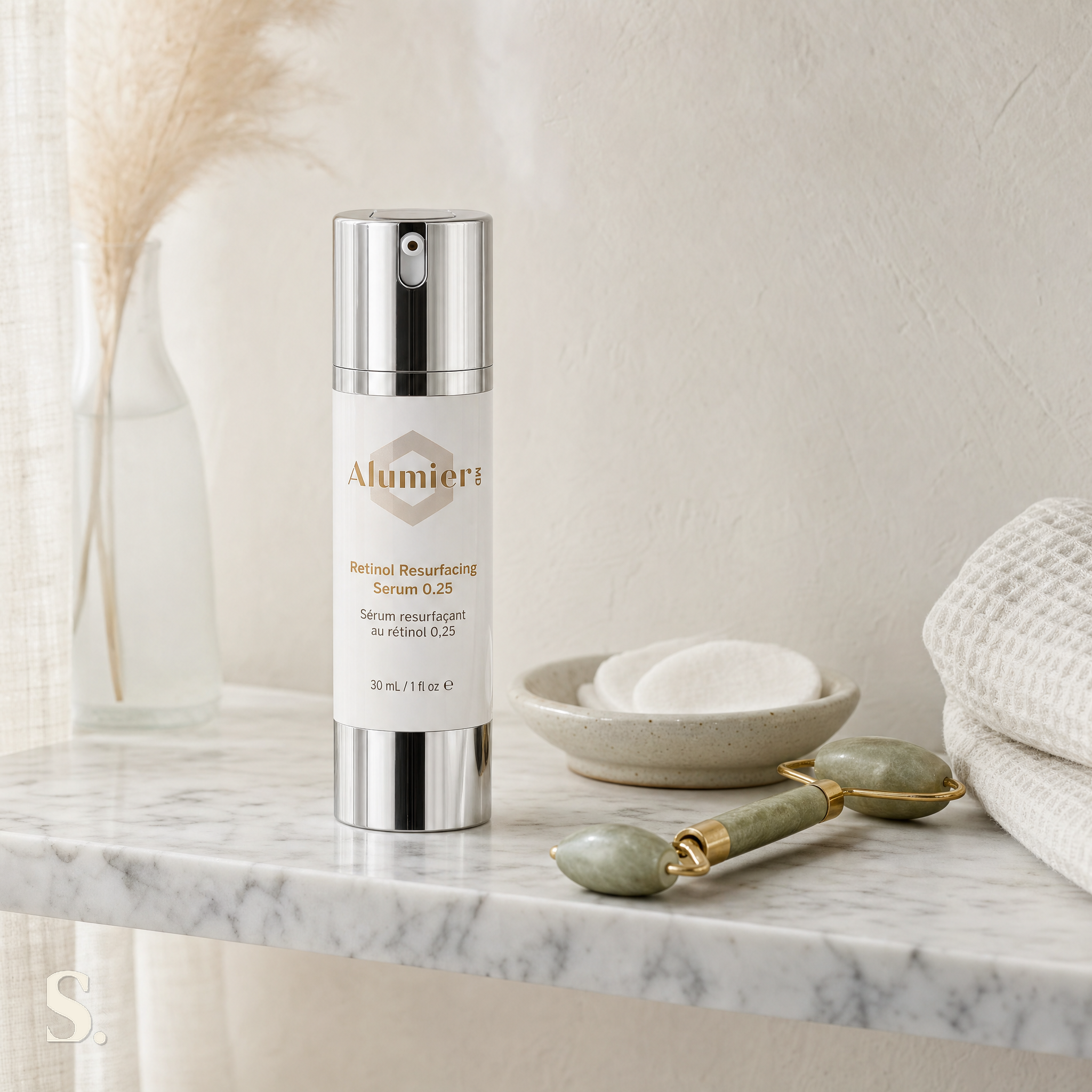
AlumierMD Retinol Resurfacing Serum is a microencapsulated pure-retinol serum sold in three strengths — 0.25%, 0.5% and 1.0% — designed for a graduated introduction to vitamin A. Niacinamide, sodium hyaluronate and soothing plant extracts sit alongside the retinol to help offset dryness, and AlumierMD's own guidance is clear that some redness, peeling or tingling should be expected while skin adjusts.
What is AlumierMD Retinol Resurfacing Serum?
Retinol Resurfacing Serum is AlumierMD's core retinol treatment, built around microencapsulation technology that houses the retinol in tiny capsules and releases it gradually overnight rather than all at once. AlumierMD positions the range to help improve the appearance of fine lines, wrinkles, blemishes and skin texture, while helping even skin tone. All three strengths share the same supporting formula — niacinamide, sodium hyaluronate and honey extract — with only the retinol concentration changing between them. The 0.5% and 1.0% strengths also add MATRIXYL Synthe'6, a peptide complex included alongside the retinol.
Key ingredients
| Ingredient | What it's there for |
|---|---|
| Retinol (microencapsulated) | The vitamin A active, at 0.25%, 0.5% or 1.0% depending on strength, released gradually overnight |
| Niacinamide | Helps strengthen skin's tolerance to retinol and supports the barrier |
| Sodium Hyaluronate | Hydrating ingredient that helps offset the dryness retinol can cause |
| MATRIXYL Synthe'6 (Tetrapeptide-14) | Peptide complex added in the 0.5% and 1.0% strengths |
The three strengths: 0.25%, 0.5% and 1.0%
Retinol Resurfacing Serum is sold as three separate 30ml products rather than one with a strength selector, so it's worth being deliberate about which one you buy.
| Variant | Retinol % | Best for |
|---|---|---|
| Retinol Resurfacing Serum 0.25 | 0.25% | First-time retinol users, or reactive/easily-irritated skin |
| Retinol Resurfacing Serum 0.5 | 0.5% | Stepping up after tolerating 0.25% comfortably |
| Retinol Resurfacing Serum 1.0 | 1.0% | Advanced users who have already tolerated 0.5% well |
AlumierMD treats 0.25% as the entry point regardless of age or prior actives experience. There's no requirement to progress through all three — many people get on well staying at 0.25% or 0.5% indefinitely.
How to use it
- When: Evening only, on cleansed skin — retinol increases sun sensitivity.
- Introducing it: Start at one to two applications a week and build up gradually, rather than applying nightly from the first use.
- Order: Apply after cleansing and before your regular moisturiser.
- Next morning: Broad-spectrum SPF, every day you're using it — not optional with any strength.
- What to expect: Mild redness, peeling or tingling can occur as skin adjusts, particularly in the first few weeks.
Who it's suitable for
AlumierMD lists Retinol Resurfacing Serum as suitable across dry, combination, oily, normal, acne-prone and mature skin, with strength selection matching the product to how reactive your skin is. If you have a diagnosed condition — rosacea, eczema or another inflammatory condition — we'd recommend a conversation with our team or your GP/dermatologist before starting, rather than assuming any strength will suit you based on a review.
Pregnancy and breastfeeding
If you're pregnant or breastfeeding, please contact our team for advice before use.
This applies to all three strengths, and to every retinol product in the AlumierMD range, including IntelliRET 0.3+ and Retinol Eye Gel. That's a conversation for you, your midwife or GP, and our team — not a blanket line in a product write-up.
Ingredients and allergens
The full INCI list for each strength is on its own product page. If you know you react to a particular ingredient, patch test on your inner arm and wait 24 hours before applying to your face, per AlumierMD's own guidance.
Retinol Resurfacing Serum vs IntelliRET 0.3+
AlumierMD runs two parallel retinol serums. Retinol Resurfacing Serum is the strength-ladder option — 0.25%, 0.5% or 1.0% with niacinamide and hydrators. IntelliRET 0.3+ uses a single 0.3% concentration but layers in gluconolactone, glutathione and MATRIXYL Synthe'6 — a more built-out formula at a fixed strength rather than a ladder to climb. See the full breakdown in our Retinol Resurfacing Serum vs IntelliRET 0.3+ comparison.
Our verdict
Retinol Resurfacing Serum does what a strength-ladder retinol should: a clear, low-risk entry point at 0.25%, a defined route up to 0.5% and 1.0% once skin has adjusted, and a supporting cast of niacinamide and hydrators included specifically to soften the introduction. It isn't a gentler alternative to retinol's usual demands — AlumierMD's own guidance is explicit that mild redness, peeling or tingling should be expected at first, and daily SPF the following morning isn't optional. Choosing the right strength to start on, rather than whichever bottle is in stock, is what determines how comfortable the first few weeks are.
FAQs
What strength of AlumierMD Retinol Resurfacing Serum should I start with?
Start at 0.25%, regardless of age or prior experience with other actives. Only move up to 0.5% or 1.0% once you've comfortably tolerated the strength below at a nightly frequency — our team can talk through your specific history if you're unsure.
Can I use AlumierMD Retinol Resurfacing Serum while pregnant?
Please contact our team for advice before use if you're pregnant or breastfeeding. We don't state a blanket safe/unsafe position on retinoids in pregnancy in our reviews — it's a conversation to have directly with us or your GP/midwife.
How long until AlumierMD Retinol Resurfacing Serum shows results?
AlumierMD doesn't publish a specific timeframe on the product pages, and results vary by strength and skin type. Retinol works through gradual cellular turnover, so most people build up to nightly use over several weeks before judging results.
Does AlumierMD Retinol Resurfacing Serum cause purging or irritation?
An initial adjustment period is common with any retinol. AlumierMD's own guidance flags that mild redness, peeling or slight tingling can occur, particularly during the first few weeks — starting at 0.25% and introducing it gradually reduces this.
Can I use AlumierMD retinol every night?
Only once your skin has built up tolerance. AlumierMD's guidance is to start with one to two applications a week and increase gradually — this phase-in applies the first time you use any strength.
What's the difference between the 0.5% and 1.0% strengths?
Both share the same base formula of niacinamide, sodium hyaluronate and MATRIXYL Synthe'6 — the difference is the retinol concentration. 1.0% is intended for skin that has already tolerated 0.5% comfortably.
Do I need sunscreen with AlumierMD Retinol Resurfacing Serum?
Yes. Retinol increases sun sensitivity, so daily broad-spectrum SPF the following morning is essential with any strength, for as long as you're using the product.