
Best AlumierMD Retinol for Your Skin
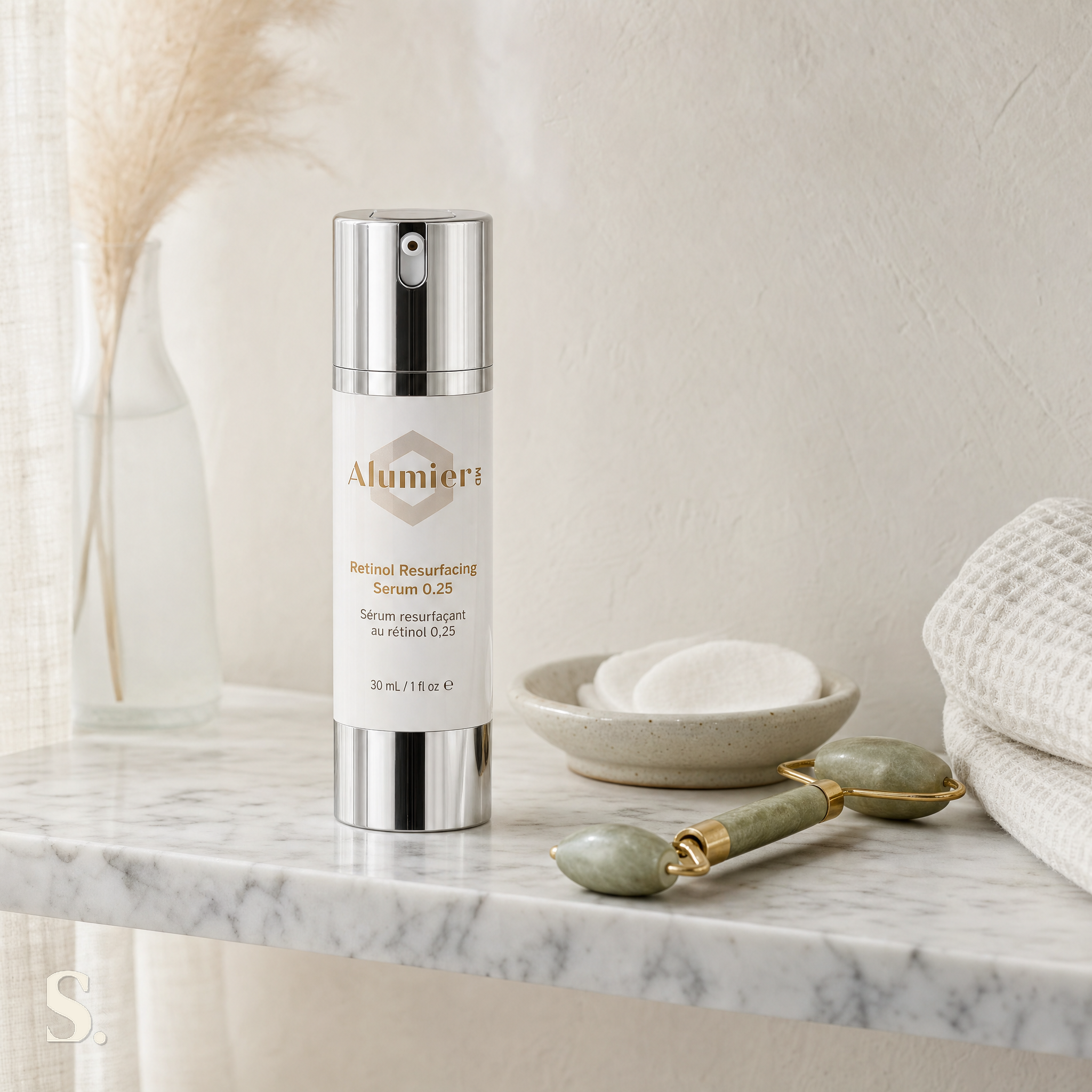
AlumierMD's retinol range has five options, not one: Retinol Resurfacing Serum in 0.25%, 0.5% and 1.0% strengths, plus IntelliRET 0.3+ and the eye-specific Retinol Eye Gel. The right one depends on your retinol history, not your age — this guide ranks each by who should start there, and where IntelliRET and the eye gel fit around the core strength ladder.
What's the best AlumierMD retinol for your skin?
All five AlumierMD retinol products share the same foundation: microencapsulated retinol, released gradually overnight rather than all at once, formulated to help improve the appearance of fine lines, uneven texture and dullness. Where they differ is strength, supporting ingredients, and what part of the face they're built for. Retinol Resurfacing Serum is the classic strength ladder — 0.25% for beginners, stepping up to 0.5% and 1.0% as skin adjusts. IntelliRET 0.3+ sits outside that ladder as a more antioxidant-supported alternative at a fixed strength. Retinol Eye Gel is formulated specifically for the eye contour and isn't a starting point for anyone new to retinol at all.
Quick comparison
| Rank | Product | Retinol % | Best for | Price band |
|---|---|---|---|---|
| 1 | Retinol Resurfacing Serum 0.25 | 0.25% | First-time retinol users, reactive skin | Entry-level |
| 2 | Retinol Resurfacing Serum 0.5 | 0.5% | Stepping up once 0.25% is tolerated nightly | Entry-level |
| 3 | Retinol Resurfacing Serum 1.0 | 1.0% | Experienced users who've tolerated 0.5% well | Entry-level |
| 4 | IntelliRET 0.3+ | 0.3% | A more built-out, comfort-led alternative to the ladder | Mid-range |
| 5 | Retinol Eye Gel | Not disclosed | The eye area only, once a face retinol is tolerated | Entry-level |
The strength ladder, ranked
1. Retinol Resurfacing Serum 0.25% — best true starting point
This is where every AlumierMD retinol journey should begin, regardless of age or prior experience with other actives. It pairs 0.25% microencapsulated retinol with niacinamide and sodium hyaluronate to help offset the dryness a new retinoid can cause. AlumierMD's own guidance is upfront that mild redness, peeling or tingling can occur while skin adjusts — this isn't a sign to stop, but a sign to keep the frequency low and build up slowly. Start with one to two evenings a week, always at night, always followed by SPF the next morning.
2. Retinol Resurfacing Serum 0.5% — the next step up
Once 0.25% is comfortably tolerated at a nightly frequency — typically after several weeks with no persistent irritation — 0.5% is the logical progression within the same range. The supporting formula stays largely consistent (niacinamide, sodium hyaluronate, plus MATRIXYL Synthe'6 added at this strength and above), so the step feels incremental rather than a formula overhaul. We wouldn't recommend starting here as a first retinol.
3. Retinol Resurfacing Serum 1.0% — for experienced skin
The top of the ladder, intended for skin that has already tolerated 0.5% well. Same core formula, higher concentration. This isn't the strength to reach for because you're impatient for results — retinol works through gradual cellular turnover regardless of concentration, and jumping strengths too fast is the most common reason people give up on retinol altogether.
4. IntelliRET 0.3+ — the antioxidant-boosted alternative
IntelliRET 0.3+ isn't a fourth rung on the Resurfacing Serum ladder — it's a parallel product built differently. Alongside 0.3% encapsulated retinol, AlumierMD includes a bio-inspired botanical booster, niacinamide, MATRIXYL Synthe'6 and — per the product's own tags — gluconolactone and glutathione, giving it a more built-out supporting cast than the base Resurfacing formula at any strength. It's positioned for people who found 0.25% Resurfacing Serum too drying, or who'd rather start with the fuller ingredient list from day one rather than progressing through the ladder. It's still a retinol and still needs the same gradual introduction — it isn't a shortcut around the adjustment period, just a differently supported route through it.
5. Retinol Eye Gel — for the eye area only, once tolerating a face retinol
Retinol Eye Gel is a separate, eye-contour-specific product built around microencapsulated retinol, niacinamide, allantoin and bisabolol — chosen to keep the thinner skin around the eyes comfortable while it works. It isn't a first introduction to retinol for anyone; the sensible order is to establish tolerance with a face retinol first (either Resurfacing Serum or IntelliRET), then add this as an eye-specific step once that's settled. Pat it in rather than rubbing, and keep it to the evening only.
Retinol Resurfacing Serum vs IntelliRET 0.3+: which route to take
If you've never used a retinol before, start on Retinol Resurfacing Serum 0.25% — it's the simpler formula and the one AlumierMD frames explicitly as the entry point. If you've already tried 0.25% and found it too drying, or you'd rather start with a heavier antioxidant and peptide cast built in from the outset, IntelliRET 0.3+ is the alternative route rather than a "stronger" option — 0.3% sits between 0.25% and 0.5% numerically, but the two products aren't designed as direct swaps for each other. For the full formulation breakdown side by side, see our Retinol Resurfacing Serum vs IntelliRET 0.3+ comparison.
How to introduce any AlumierMD retinol
- Patch test first, and apply to clean, fully dry skin — damp skin can increase sensitivity.
- Start with one to two evenings a week, not nightly, and build up gradually over several weeks.
- Keep other strong actives — exfoliating acids, vitamin C — off the same nights while you're building tolerance.
- Moisturise afterwards if skin feels tight; a simple, fragrance-light moisturiser is usually enough.
- Wear broad-spectrum SPF every morning without exception. Retinoids increase photosensitivity, and this applies for as long as you're using any of the five products above.
- If irritation goes beyond mild, temporary flaking, drop back to a lower strength or reduce frequency further before pushing on.
Building a retinol night into your routine
- Cleanse and pat skin completely dry.
- Wait a few minutes before applying — this alone reduces stinging on damp skin.
- Apply your retinol, avoiding the eye area unless you're specifically using Retinol Eye Gel there.
- Follow with a plain, fragrance-light moisturiser to seal everything in.
- Save exfoliating acids and vitamin C for non-retinol nights while tolerance is still building.
The following morning, broad-spectrum SPF is the step that protects everything the retinol is working towards — it isn't optional at any strength.
Who shouldn't jump straight to a higher strength
Anyone new to retinol, full stop — regardless of age, skin type, or how "resilient" your skin usually is. Very reactive or barrier-compromised skin should start on 0.25% Resurfacing Serum specifically, under guidance, rather than IntelliRET 0.3+ or a higher-strength Resurfacing variant. If you have a diagnosed skin condition, are using prescription treatments, or aren't sure where to start, a quick conversation with our team is worth more than picking a strength based on this guide alone.
Pregnancy and breastfeeding
If you're pregnant or breastfeeding, please contact our team for advice before use. This applies to all five products covered here — Retinol Resurfacing Serum at every strength, IntelliRET 0.3+ and Retinol Eye Gel — and to AlumierMD retinoids generally.
Frequently asked questions
Which AlumierMD retinol should I start with?
Retinol Resurfacing Serum 0.25% is the right starting point for anyone new to retinol, regardless of age. Only move up to 0.5%, 1.0% or across to IntelliRET 0.3+ once your skin has comfortably tolerated the step below.
Is IntelliRET 0.3+ stronger than Retinol Resurfacing Serum 0.25%?
Numerically, 0.3% sits between 0.25% and 0.5%, but they aren't designed as a strict strength progression — IntelliRET is a differently formulated product with a heavier supporting cast, not simply "the next step up" from 0.25%. See our full comparison for the formulation differences.
Can I use Retinol Eye Gel as my first-ever retinol?
We wouldn't recommend it. Establish tolerance with a face retinol first — either Retinol Resurfacing Serum or IntelliRET 0.3+ — then add Retinol Eye Gel as a targeted step once that's settled.
How long until I see results from an AlumierMD retinol?
AlumierMD doesn't publish a specific timeframe, and it varies by strength, product and how consistently it's used. Retinol works through gradual cellular turnover, so most people build to nightly use over several weeks before judging results.
Can I use two AlumierMD retinol products at once — say, a face serum and the eye gel?
Yes — Retinol Eye Gel is formulated for the eye contour specifically and is designed to sit alongside a face retinol like Resurfacing Serum or IntelliRET 0.3+, once both are individually tolerated. Introducing them at the same time as each other isn't the approach we'd suggest.
Is any AlumierMD retinol safe during pregnancy?
If you're pregnant or breastfeeding, please contact our team for advice before use — this applies across the whole retinol range covered here.
Do I need sunscreen with every AlumierMD retinol?
Yes, without exception. All five products increase skin's sun sensitivity, so daily broad-spectrum SPF the following morning applies regardless of which one you're using or how long you've used it.