
Best Alastin Product for Brightening and Uneven Tone
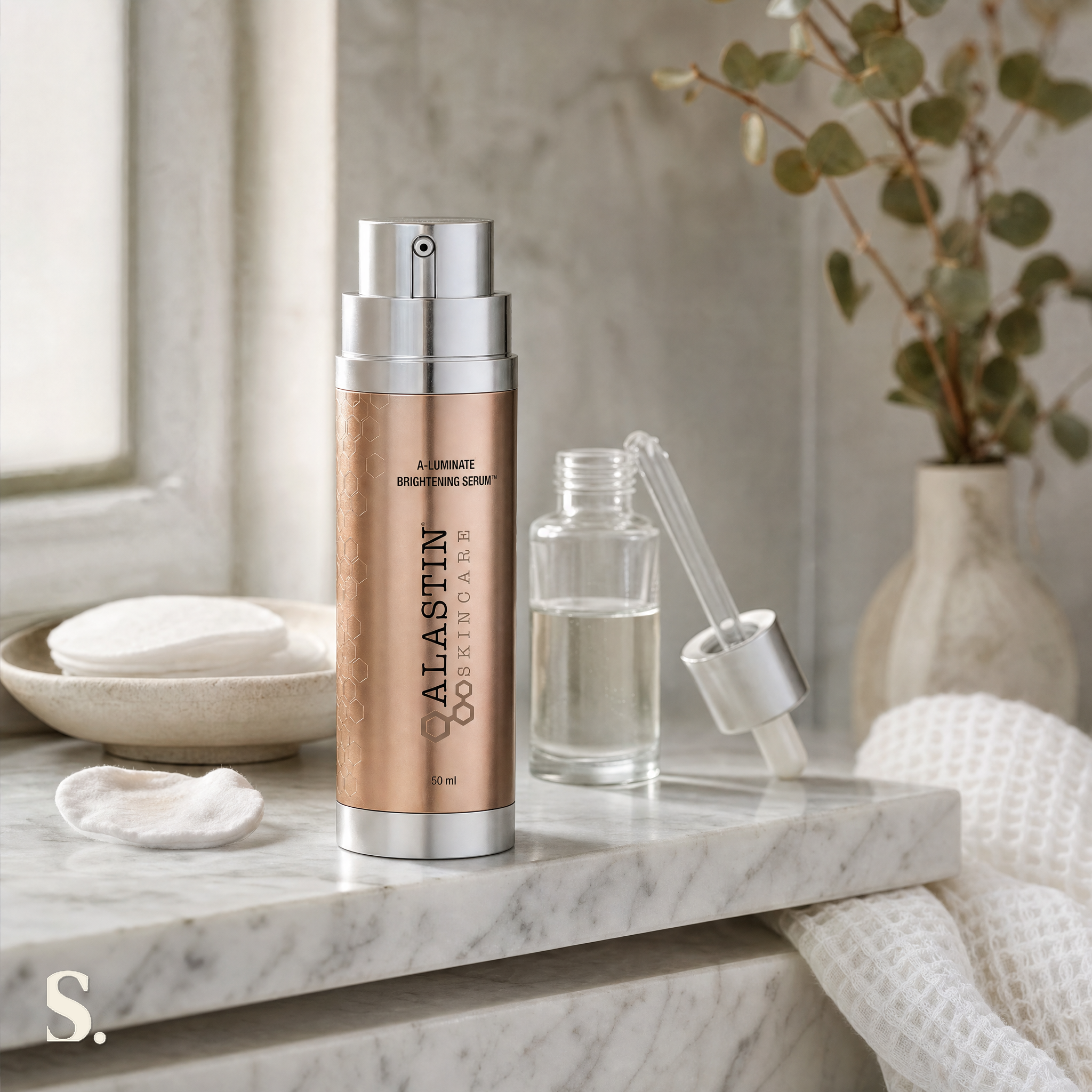
Alastin makes exactly one dedicated brightening serum for uneven tone: A-LUMINATE Brightening Serum™. It's a hydroquinone-free, niacinamide-and-squalane formula designed to help improve the appearance of dark spots, sun-related discolouration and uneven tone, priced at £145 for 50ml. If you came here expecting a shortlist to compare, there isn't one — this is a single-product category, and we'd rather say so plainly than pad the page out.
Why this is a one-product list
Alastin does sell a second serum with antioxidant, brightening-adjacent positioning — C-Radical Defense Antioxidant Serum™ — which would ordinarily sit alongside A-LUMINATE here. We're leaving it off this page for now. Its current product listing carries ingredient information that doesn't match up with what the product is meant to be, and we don't publish product-specific claims until that's been checked and corrected. If that's resolved, we'll add it. Until then, A-LUMINATE stands alone as Alastin's brightening recommendation.
Quick facts: Alastin A-LUMINATE Brightening Serum™
| Key actives | Niacinamide, Squalane |
|---|---|
| Secondary actives | Hexapeptide-11 and Hexapeptide-12 (encapsulated), Lactoferrin |
| Format | Lightweight serum, 50ml |
| Price | £145 |
| Skin types | All skin types, including sensitive skin |
| AM/PM | Both — twice daily |
| Application | Full face, not a spot treatment |
| Free-from | Hydroquinone-free, retinol-free, fragrance-free |
What's actually in it
A-LUMINATE is built around Niacinamide (Vitamin B3), included to help support a more even-looking skin tone and a stronger skin barrier, alongside Squalane for lightweight hydration. Encapsulated Hexapeptide-11 and Hexapeptide-12 — two peptides carried in liposomes — sit alongside Lactoferrin, and the formula is rounded out with Silybum Marianum (Milk Thistle) Extract and Silver Mushroom Extract for antioxidant support. It also contains optical brighteners (Tin Oxide and Titanium Dioxide), which give an immediate, temporary luminosity on application rather than a lasting change to pigmentation.
Alastin's own product listing also references "Tranexamic Acid" and a proprietary "PATH-3 Technology" as part of the formula's positioning. We haven't been able to confirm either against the product's structured ingredient data, so neither is treated as a confirmed active here — see the data gap note below.
What Alastin's own testing reports
Alastin states that, in its own consumer-use testing, 86% of participants reported a visible reduction in dark spots and discolouration after 8 weeks, rising to 90% reporting brighter, more radiant skin at 12 weeks of consistent use. This is the brand's own reported result, not an independently verified clinical trial, and Alastin doesn't publish a named study or journal reference for it on the product listing — so treat it as a manufacturer claim rather than third-party evidence.
Who it's for
- Post-inflammatory hyperpigmentation, sun-related dark spots, age spots or melasma-prone skin looking for a hydroquinone-free option
- All skin types, including sensitive skin, per Alastin's own product positioning
- Anyone wanting a brightening step that can be layered with retinol at night — Alastin positions A-LUMINATE as going on before a retinoid in a PM routine
Who should skip it
- Anyone wanting a spot-treatment product — A-LUMINATE is designed for full-face application to help prevent new pigmentation forming, not for dabbing on individual marks
- Shoppers who specifically want a vitamin-C-led brightening serum — A-LUMINATE's confirmed actives are niacinamide and squalane, not ascorbic acid, so if vitamin C is the priority, it isn't the right fit here
- Anyone pregnant or breastfeeding without professional advice — see the note below
How A-LUMINATE compares to brightening serums outside the Alastin range
Because A-LUMINATE is the only Alastin product in this category, the more useful comparison for most shoppers is against a brightening serum from a different brand. Our A-LUMINATE vs SkinCeuticals Discoloration Defense comparison sets the two side by side — both are hydroquinone-free, niacinamide-adjacent formulas aimed at similar concerns, stocked on the same site. For the fuller picture on Alastin as a brand, including how A-LUMINATE fits alongside the rest of the TriHex Technology® range, see the Alastin reviews hub, or read the standalone A-LUMINATE Brightening Serum review for the full ingredient and usage breakdown.
Our verdict
There's no ranking to do here, so the honest answer is the useful one: if you want an Alastin product for dark spots or uneven tone, A-LUMINATE Brightening Serum is the one to look at, and currently the only one we can review with confidence. It's a hydroquinone-free, niacinamide-and-squalane formula suited to most skin types including sensitive skin, designed for full-face daily use rather than spot treatment. If you're comparing against options outside Alastin, or want the full ingredient breakdown before buying, the links above cover both.
If you're pregnant or breastfeeding, please contact our team for advice before use.
Frequently asked questions
Does Alastin make more than one brightening serum?
Currently just one that we can review with confidence: A-LUMINATE Brightening Serum. Alastin also sells C-Radical Defense Antioxidant Serum, which would normally sit in this category, but its product listing has an unresolved data-quality issue, so we're not reviewing it until that's corrected.
Is A-LUMINATE hydroquinone-free?
Yes. Alastin formulates it without hydroquinone or retinol, using niacinamide, squalane and encapsulated peptides as its confirmed actives instead.
Can I use A-LUMINATE with retinol?
Alastin positions A-LUMINATE as a step that goes on before a retinoid in an evening routine. If you're introducing both together for the first time, it's worth patch testing and building up gradually rather than starting daily use of everything at once.
Does A-LUMINATE work on melasma?
Alastin markets it as suitable for melasma-prone skin among other forms of discolouration, and its own reported testing covers dark spots and discolouration broadly. Melasma can be a genuinely stubborn, hormonally-linked condition, so if it's your main concern, we'd recommend speaking to our team or a clinician about a tailored approach rather than relying on any single serum.
Is Alastin A-LUMINATE safe to use if I'm pregnant or breastfeeding?
If you're pregnant or breastfeeding, please contact our team for advice before use.
How does A-LUMINATE compare to a vitamin C serum for brightening?
A-LUMINATE isn't a vitamin C serum — its confirmed actives are niacinamide and squalane, not ascorbic acid. If you're specifically after vitamin C for brightening, our wider guide to the best vitamin C serums in the UK covers that ground across multiple brands instead.