
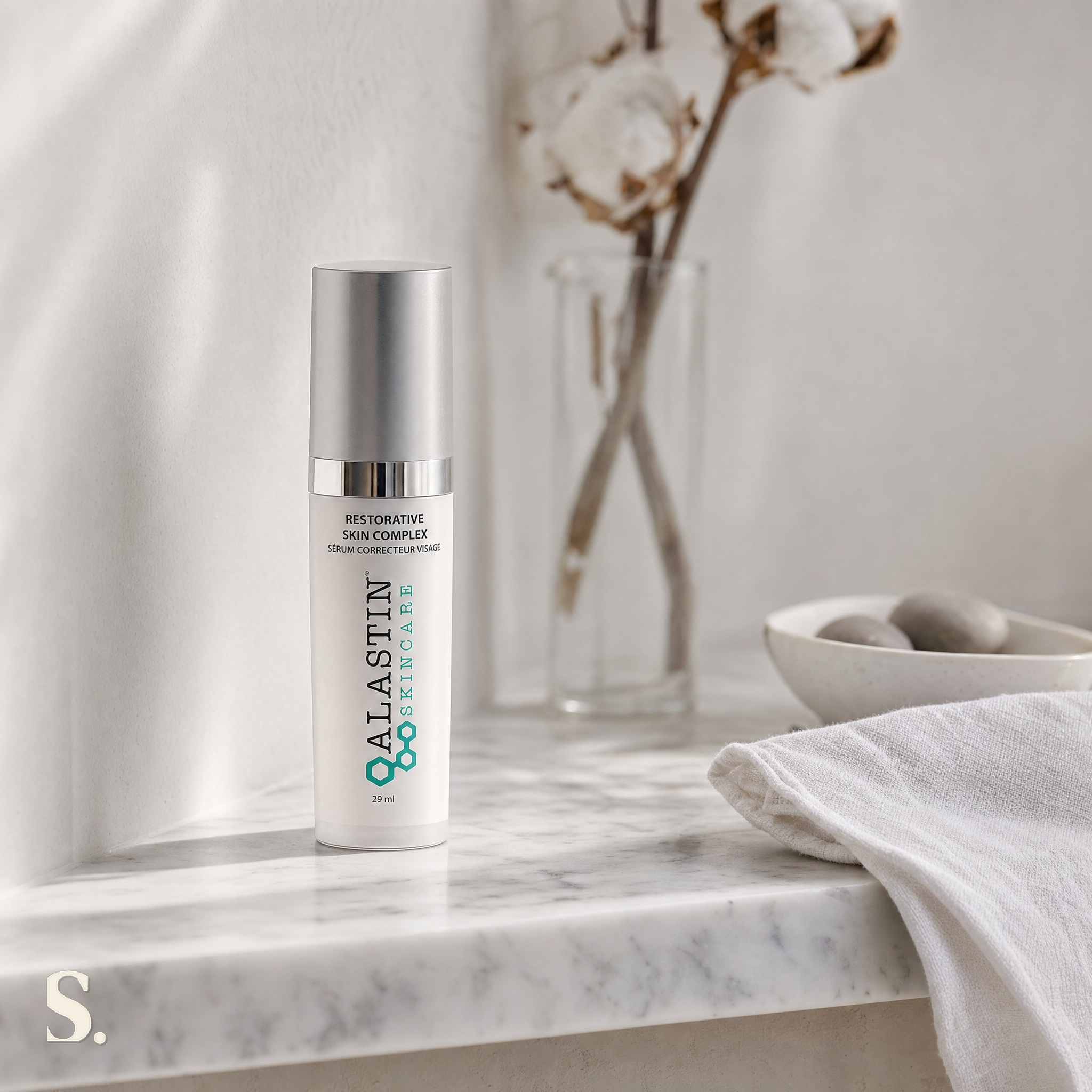
ALASTIN Restorative Skin Complex™ 29.6ml
The Verdict
A well-formulated, peptide-dense daily serum backed by Alastin's own 12-week study data, best suited to established skincare users who want the brand's most concentrated daily anti-ageing formula. At £180 it's a premium buy, and two genuine gaps — unconfirmed fragrance status and no published INCI percentages — mean it's worth a patch test and a direct check with Alastin before committing, especially if fragrance sensitivity is a concern. First-time Alastin buyers may prefer a cheaper entry point into the range.

ALASTIN Restorative Skin Complex™ is the brand's flagship daily peptide serum, built around TriHex+™ — an expanded version of Alastin's patented peptide technology. It costs £180 for 29.6ml and leans on Niacinamide plus a peptide complex including Palmitoyl Hexapeptide-12, Palmitoyl Tripeptide-1 and Tetrapeptide-30. Alastin's own 12-week study reported high satisfaction and hydration scores — details attributed to the brand's testing below, not independently verified by Skintique.
What Is ALASTIN Restorative Skin Complex?
Restorative Skin Complex is Alastin's core anti-ageing serum, designed for daily use on the face rather than a single-zone product like the brand's neck or eye formulas. It's built around TriHex+™ technology, Alastin's term for a blend of active peptides — Palmitoyl Hexapeptide-12, Palmitoyl Tripeptide-1 and Tetrapeptide-30 — which the brand says work together to support the skin's own processes for clearing damaged collagen and elastin, making way for new collagen and elastin production. TriHex Technology® itself is covered by a US patent (No. 10,286,030), which is a legal filing detail rather than a clinical guarantee.
Alongside the peptide blend, the formula includes Niacinamide (Vitamin B3) for visible tone concerns, Tremella Fuciformis (Silver Mushroom) extract for hydration support, and Ceramide AP and Ceramide NP to support the skin barrier. It's a lightweight, fast-absorbing serum dispensed via a pump, intended to sit under moisturiser and SPF.
Key Actives
| Active | Role |
|---|---|
| Niacinamide | Antioxidant; helps improve the appearance of pigmentary concerns and skin dullness |
| Palmitoyl Hexapeptide-12 | Peptide within the TriHex+™ complex |
| Tetrapeptide-30 | Peptide within the TriHex+™ complex |
| Palmitoyl Tripeptide-1 | Peptide within the TriHex+™ complex |
| Tremella Fuciformis (Silver Mushroom) Extract | Hydration support |
| Ceramide AP / Ceramide NP | Skin-barrier support |
DATA GAP: Alastin does not publish exact INCI percentages for any active in this formula, so no strength figures are given here — treat any percentage you see elsewhere with caution unless it's sourced directly from Alastin.
What Alastin's Own Clinical Data Shows
Alastin describes Restorative Skin Complex as "clinically validated" through 12-week, multi-centre studies it commissioned itself. Per the brand's own product information, results included 98% of participants reporting improved skin hydration, 89% reporting improved overall skin texture, and 93% reporting overall satisfaction, alongside a 53.86% increase in measured facial skin hydration after 12 weeks. Alastin also cites histology data showing new adipocyte (fat cell) stimulation, which it links to addressing visible volume loss at a cellular level.
These are the brand's own figures from its own testing programme, not an independent clinical trial, and Skintique has not reviewed the underlying study data. Treat them as manufacturer-reported evidence rather than proof of a guaranteed personal result — used here only to describe what the serum helps improve the appearance of, not what it treats, cures or reverses. The product has also picked up editorial recognition, including Women's Health's "Best Moisturiser for Mature Skin 2021" and a "Best Wrinkle Treatment" mention from Prevention Magazine, both independent of Alastin's own study.
Who It's For
- Established skincare users who want the most peptide-dense daily serum in the Alastin range
- People with fine lines, uneven texture, dullness or early volume loss looking for a daily anti-ageing step, on top of (not instead of) sunscreen
- Fitzpatrick skin types I–VI, which the brand's own study population covered — Alastin positions this serum as broadly suited across skin tones
- Patients advised by a practitioner to add a daily TriHex+™ serum alongside procedure-specific Alastin products
Who Should Skip It
- First-time Alastin buyers who want to trial the brand more cheaply — at £180, this sits at the top of the range alongside Regenerating Skin Nectar; a lower-cost product like HA IMMERSE Serum is a cheaper way in
- Anyone with confirmed fragrance sensitivity who needs certainty before buying — see the fragrance note below
- Anyone expecting a same-week transformation — Alastin's own study window is 12 weeks, and the brand does not claim faster results
How to Use It
Alastin's directions call for one to two pumps, applied morning and evening to clean skin, layered under moisturiser and (in the morning) sunscreen. It's positioned as a daily maintenance step rather than an occasional treatment.
DATA GAP: Alastin has not published patch-test guidance specific to this product on its PDP. Standard practice for any new skincare product — patch-testing on a small area first — applies here as it would to any serum, not as a claim specific to this formula.
Pregnancy or breastfeeding safety is not addressed on Alastin's own product page for this serum, so it isn't stated here either. If you're pregnant or breastfeeding, please contact our team for advice before use.
Fragrance Status: A Genuine Data Gap
Most of the Alastin range is explicitly labelled fragrance-free on its own product pages. Restorative Skin Complex is the exception: its "Free-From Claims" only confirm non-comedogenic and hypoallergenic — fragrance status isn't stated either way. If fragrance sensitivity is a firm dealbreaker for you, patch-test first and check directly with Alastin rather than assuming this serum is fragrance-free like its siblings.
Restorative Skin Complex vs Restorative Neck Complex
These two are the most commonly confused products in the range, because they share the TriHex peptide mechanism and a similar name. Restorative Skin Complex (£180/29.6ml) is formulated for the face; Restorative Neck Complex (£105/50ml) is formulated specifically for the neck and décolletage, an area most facial skincare skips. Neither is a substitute for the other — see our full Restorative Skin Complex vs Restorative Neck Complex comparison for the side-by-side breakdown.
Restorative Skin Complex vs Regenerating Skin Nectar
Both sit at the same £180 price point, which is the main reason shoppers mix them up — but they're built for different jobs. Restorative Skin Complex is the everyday peptide-dense anti-ageing serum described on this page. Regenerating Skin Nectar is Alastin's broader pre- and post-procedure serum, formulated around a different, silicone-based base and also used long-term by some patients as a daily serum, per its own product page. If you're choosing between them purely on price, that's the wrong signal — the use-case, not the cost, should decide.
Where This Fits in a Wider Routine
Restorative Skin Complex is one of three Alastin products built on the same TriHex mechanism but applied to different areas of visible ageing — face, neck and body. See our Best Alastin products for crepey or sagging skin guide for how this serum, Restorative Neck Complex and TransFORM Body Treatment work together as "one mechanism, three areas." For a wider introduction to how the whole range is organised, start with the Alastin brand guide.
Frequently Asked Questions
Is ALASTIN Restorative Skin Complex worth the money?
At £180 for 29.6ml, it's one of the pricier serums in the Alastin range. Whether it's worth it depends on whether you want the brand's most peptide-dense daily formula and are comfortable relying on Alastin's own 12-week study data rather than independent trials — for a cheaper way to trial the brand, consider HA IMMERSE Serum first.
What does TriHex+™ mean?
TriHex+™ is Alastin's name for an expanded version of its patented TriHex Technology® peptide complex, used in this serum. The brand says it supports the skin's own processes for clearing damaged collagen and elastin, helping the way for new collagen and elastin production.
How long until ALASTIN Restorative Skin Complex works?
Alastin's own study measured results at 12 weeks of consistent use. There's no brand-published data for faster timelines, so 12 weeks is the honest benchmark to expect rather than immediate change.
Is ALASTIN Restorative Skin Complex fragrance free?
This is a genuine data gap. Alastin's product page confirms it's non-comedogenic and hypoallergenic but doesn't state fragrance status either way — unusual for this range, where most products are explicitly labelled fragrance-free. Patch-test first if fragrance sensitivity is a concern.
Can I use ALASTIN Restorative Skin Complex with retinol?
Alastin's own product page doesn't give specific combination guidance for retinol. As general practice, introduce any new active gradually and watch for irritation — if you're unsure how to combine it with an existing retinol routine, our team can advise.
What skin type is ALASTIN Restorative Skin Complex for?
Alastin lists it as suitable for oily, combination and dry skin. Unlike most of the range, the product page for this specific serum doesn't explicitly list "sensitive" skin — worth noting if that applies to you.
ALASTIN Restorative Skin Complex vs Regenerating Skin Nectar — what's the difference?
Both cost £180, which is where the confusion starts. Restorative Skin Complex is the daily anti-ageing serum described on this page; Regenerating Skin Nectar is built around a different base and positioned more broadly for pre- and post-procedure use, though some patients use it daily long-term too. See the comparison above for the full breakdown.